The Heart is a Pump : Short version
Short version of "The Heart is a Pump"
First, a diagram of the human blood pressure, plotted over the course of the circulatory system: from the aorta, through the system, back to the superior venae cavae (just before entering the right atrium). ( from 20.2 Blood Flow, Blood Pressure, and Resistance – Anatomy & Physiology (oregonstate.education) This is a snapshot at one moment; obviously the pressure wave would propagate to the right if we were looking at a real time plot.
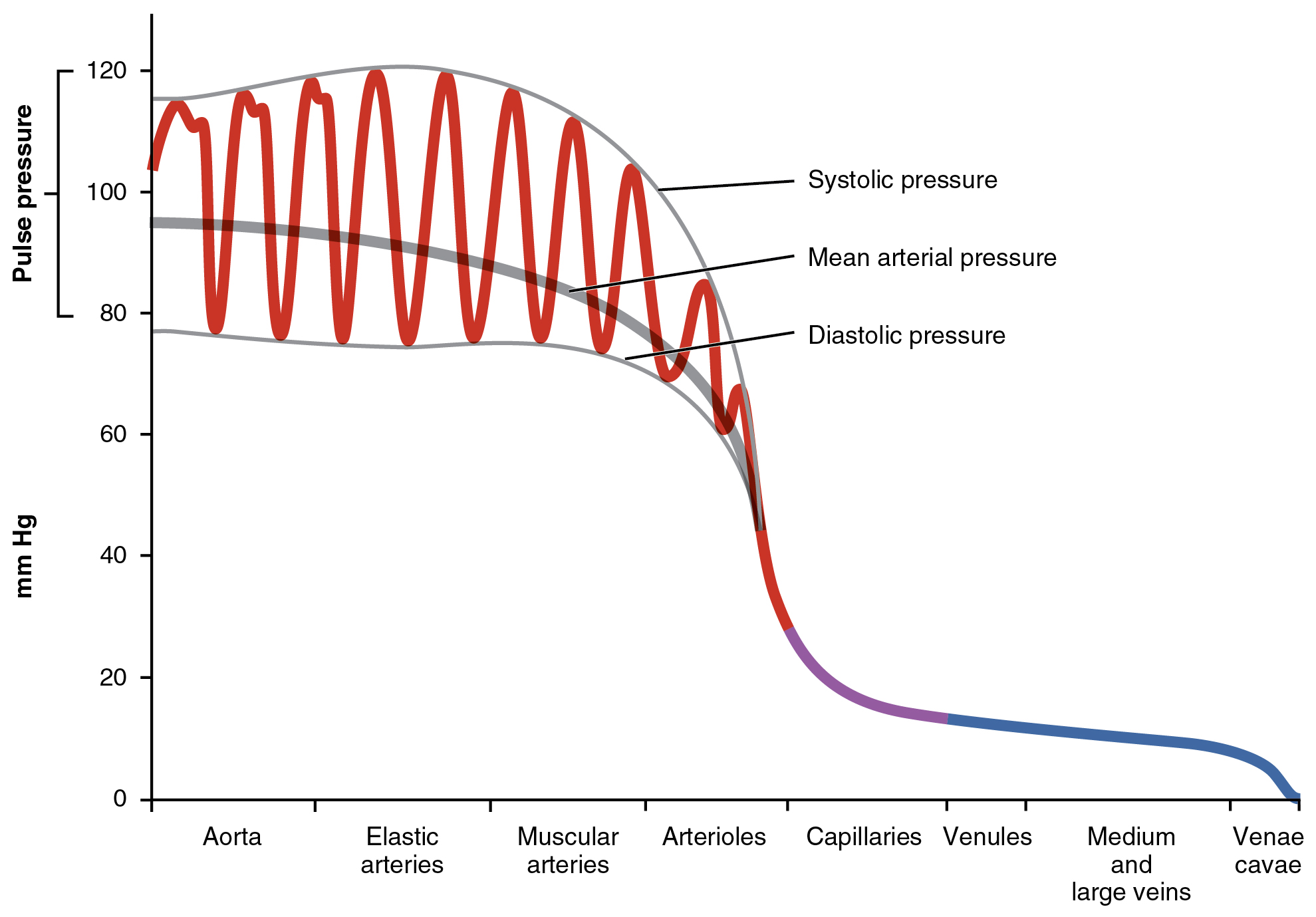
Notice the blood leaves the heart at a mean pressure of about 95 mm Hg. It arrives back at the heart through the right venae cavae, at a pressure of basically zero.
In my very simple block diagram below, the blood leaves the heart at (A) an average pressure of about 100 mm Hg (I drew it from memory before seeing the above chart). The blood travels through all the arteries, etc. etc. organs, veins, etc., back to the heart, at an average input pressure of 10 mm Hg or less (at B). It's a rough approximation.
1. We all agree that the blood moves forward through the heart, on average, from B to A (from left to right on the diagram below).
2. The pressure increases from B to A by about 90 mm Hg, on average.
The only way this could happen in our universe, is the heart is doing actual work to push on the fluid, which results in an increase in pressure at A. Notice that I said "results in an increase in pressure" rather than "causes an increase...". That's because pressure is caused by several factors, including the downstream resistance. The common term for something that moves a fluid from a low pressure area to a higher pressure area is "pump". I can't think of a better word, can you?
Here's the basic calculation:
Power = q (flow) X p (pressure change) / E (energy Efficiency)
Flow rate is approximately 5 Liters per Minute at "rest".
Flow rate = 5 L/min = 8.33E-5 cubic meters per second.
Pressure increase = 90 mm Hg = 12,000 Pa
E = 0.25 (https://academic.oup.com/cardiovascres/article/48/1/4/363255 )
There is lots of research that shows the human body produces up to about 100 Watts of power. Is it not reasonable to accept that the heart does 4% of the total? Some writers have said that *if* the heart is a pump, then it's doing a "truly prodigious task". That's a subjective exaggeration, based on the unproven premise that the circulatory system has a very high resistance. Human power - Wikipedia

That was the simple engineering solution above. But, if that does not convince you, let's answer another myth put forth by the "heart is not a pump" folks:
1. There's a mysterious force pushing the blood along, inside the capillaries / veins that does most of the work, which means the heart is just responding, or acting as an "organ of impedance".
Here's an example of a lack of scientific clarity in a medical school text:
20.2 Blood Flow, Blood Pressure, and Resistance – Anatomy & Physiology (oregonstate.education)The first paragraph here is correct, the second contradicts it:
"When vascular disease causes stiffening of arteries, compliance is reduced and resistance to blood flow is increased. The result is more turbulence, higher pressure within the vessel, and reduced blood flow." (CORRECT. More resistance = higher pressure = LOWER flow)
"Blood volume, blood pressure, and blood flow are directly proportional to one another. Water may merely trickle along a creek bed in a dry season, but rush quickly and under great pressure after a heavy rain. Similarly, as blood volume decreases, pressure and flow decrease. As blood volume increases, pressure and flow increase."
"Also notice that, as blood moves from venules to veins, the average blood pressure drops, but the blood velocity actually increases. This pressure gradient drives blood back toward the heart. Again, the presence of one-way valves and the skeletal muscle and respiratory pumps contribute to this increased flow."
The first sentence is correct, but then "increased flow" is not clear in the 3rd sentence. The only thing that causes the "increased flow" (they mean "velocity" as stated in the previous sentence) is the reduction in total cross-sectional area of the veins as we go toward the heart; Simply the conservation of mass and momentum. The muscle action and one-way valves assist in pushing the blood forward, but the phrase "increased flow" is misleading. In any single section of vein, the mass-flow-rate entering must equal the mass-flow-rate exiting, on average, otherwise we would be creating or destroying matter, right? To truly appreciate what's going on, you have to study parallel circuits, and know that the vessels and capillaries branch outward in a beautiful fractal manner, then back again. And, the total cross-sectional area of all the capillaries is a thousand times greater than the area of the aorta, so that's why the circulatory system has a low resistance. (Reference: Vasculature – Anatomy and Physiology (hawaii.edu) )
6/15/2023 (fixed broken links Oct. 2024)

Comments
Post a Comment