The Heart as a Combination of an Oscillating Centrifugal Pump and a Reciprocating Positive Displacement Pump
The Heart is a Combination of an Oscillating Helical-Axial Pump and a Reciprocating Positive-Displacement Pump
By David Grunberg, B.Sci.
(Nov 2020 - Jun 2022)
The commonly held model of the heart is it is a simple displacement pump (actually two pumps), with the ventricles providing all the motive energy to push the blood by "squeezing", and with valves that constrain the flow to the forward direction.
Partly in response to this simplified model, some individuals have proposed "the heart is not a pump". Some of their observations rightly and curiously do not fit exactly with the simple displacement pump model. This has led, unfortunately, to an all-or-nothing stance.
My view is that the heart certainly is a pump - just more complex than the one commonly presented.
FIRST: Proof that the heart is a pump of some type.
The pressure diagram below, as actually observed: The pressure in the aorta (the output artery) is clearly always higher than the atrial pressure (the input side). Since fluid will, on average, always move from a high pressure location to a lower pressure location if unobstructed, then, if the heart were NOT a pump, the blood would flow backwards! Obviously that does not happen. The only thing that can move fluid, in a closed system, from a low pressure location to a higher pressure location is some sort of pump.
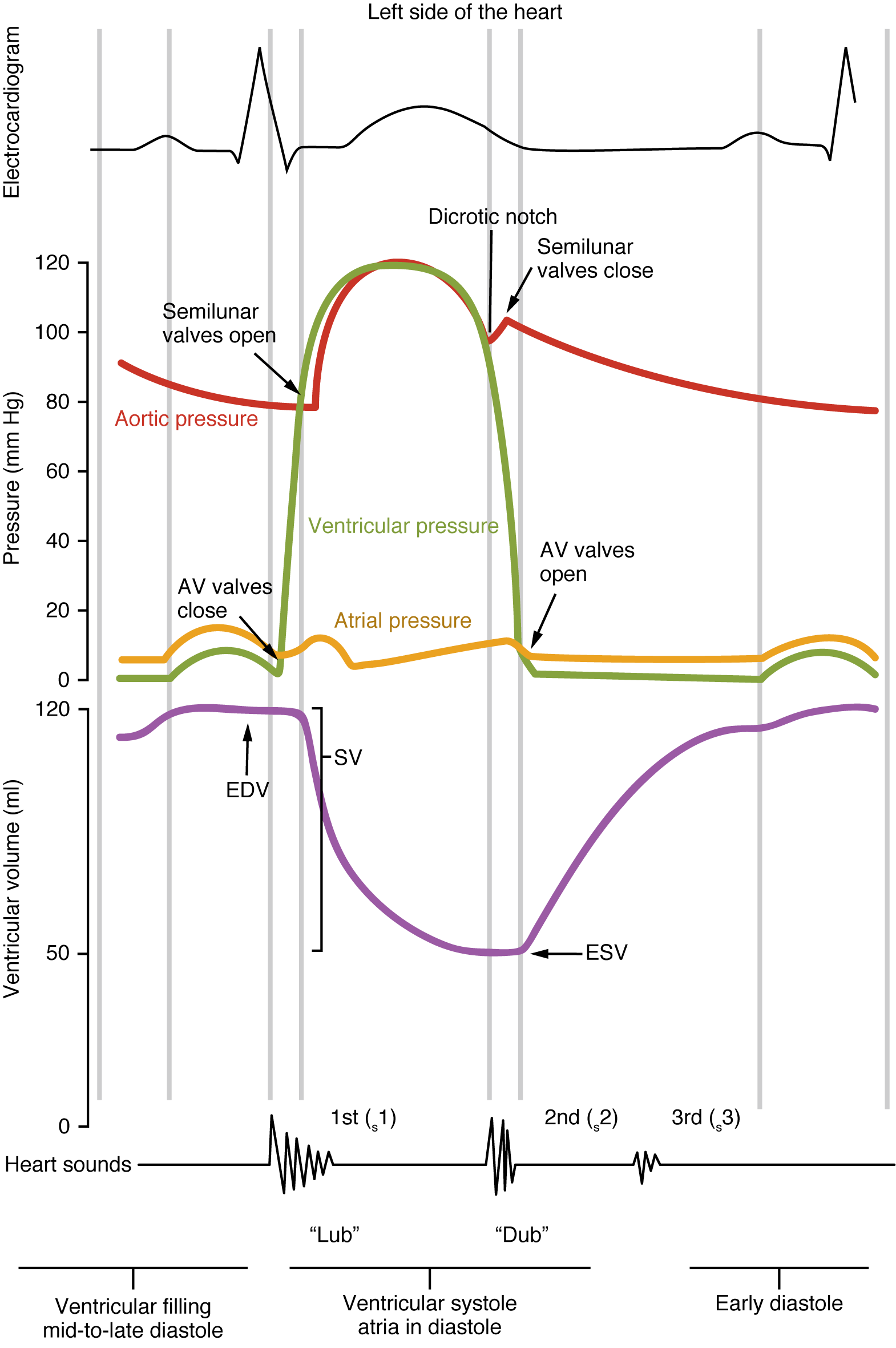
19.3 Cardiac Cycle – Anatomy & Physiology (oregonstate.education)
For a more detailed explanation, see The Heart Is a Pump (bmw-genius.blogspot.com)
Looking at the various data available, it seems that a combination of pumping principles are in play.
The momentum of the blood could cause anomalies in observations because the vessels are flexible; under systolic pressure, the vessels dilate which results in two interesting things: 1) The initial pressures in some places (at the beginning of systole) will be lower than expected but build up after a delay, and 2) as the arteries stretch they will store up potential energy, so when they contract later they impart that energy to the blood movement. It might appear that the vessels are "actively" pushing the blood at certain moments (or that the blood is "self-propelled") -- but all the kinetic energy originates in the heart.
Momentum of the blood could allow brief moments when the blood appears to move from a low pressure area to a higher pressure area "of its own power," but remember its momentum originally came from the heart muscle.
VORTEX
Some observations reveal a vortex of flow inside the left ventricle, with an area of lower pressure in the center.
Some observations show that the circulation can move somewhat with malfunctioning heart valves.
It functions by spinning and imparting an angular momentum to the fluid. The momentum causes the fluid to eject from the outlet in the direction of velocity at that point on the circumference.
The heart ventricle could be an oscillating pump that combines the two principles of displacement AND centrifuge: squeezing and rotating through some angle, then expanding and rotating back to the original position. This action would result in both a vortex and moments of relatively low pressure in the center of the ventricle, and therefore is not a "paradox" that the ventricle is indeed pumping.
I found an invention that uses the oscillating centrifuge principle, but not displacement:
Oscillating Centrifugal Pump
Sipin; Anatole J. , 1992/1995
https://patents.google.com/patent/US5405251
REFERENCES
The Heart Is a Pump (bmw-genius.blogspot.com)
https://fluidflowinfo.com/closed-loop-systems/
https://teachmephysiology.com/cardiovascular-system/circulation/flow-within-cardiovascular-system/
Helico-axial pump example
https://patents.google.com/patent/US20110280706A1/en


Comments
Post a Comment